
About the Book
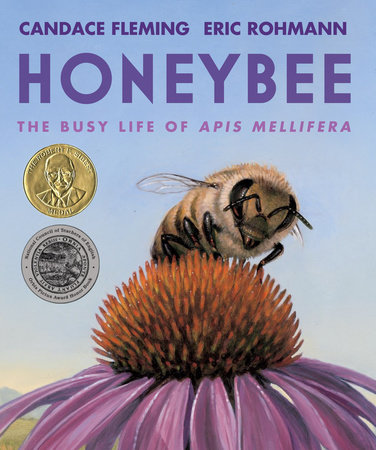
Honeybee: The Busy Life of Apis Mellifera follows the journey of a honeybee as she works hard to help her hive. It teaches us about the important role bees play in nature
About the Author
Candace Fleming loves to tell fun and creative stories, just like she did when she was a kid. She enjoys history and language, making her books exciting and educational for young readers


About the Illustrator
Eric Rohman began drawing as a way to better understand the world around him and enjoys making books he wants to see that haven’t been made yet. He likes making kids books best because he believes they are the best audience!
Awards
- 2021 Robert F. Siebert Medal
- Orbis Pictus Honor
Publisher
Neal Porter Books, an imprint of Holiday House
Learning Activities
Discussion Questions
Grade 1:
- What did you learn about honeybees that you didn’t know before? (RI.1.1)
- Can you describe the different stages of a honeybee’s life? (RI.1.2)
- What does a honeybee do to help its hive? (RI.1.3)
- How do the illustrations help you understand the story of the honeybee? (RI.1.7)
Grade 2:
- What did you find the most interesting about the honeybee’s life? Why? (RI.2.1)
- What are some jobs a honeybee does during its life? (RI.2.3)
- How do honeybees communicate with each other? (RI.2.6)
- Explain how the picture on pages 11-12 help you understand what is being described in the text on those pages. (RI.2.7)
- Why are honeybees important to our environment? (RI.2.8)
Grade 3:
- What are some of the challenges that honeybees face, and how do they overcome them? (RI.3.1)
- Use the facts and details from the story to explain the life of a honeybee. (RI.3.1)
- What are the different stages of a honeybee’s life, and how are each of them important? (RI.3.3)
- Describe the seven parts of a honeybee and their functions. (RI.3.7)
- Why are honeybees important to the environment, and what can we do to help protect them? (RI.3.8)
Writing Activities
Grade 1:
- Draw a picture of a honeybee and write a sentence about what it is doing based on a fact from the book. (W.1.2)
- Write a diary entry from the perspective of a honeybee. What did the honeybee do today? (W.1.3)
Grade 2:
- Write a letter to a honeybee thanking it for its hard work. Be sure to mention some of the important jobs it does. (W.2.1)
- Write a short report about the life cycle of a honeybee. Include at least 3 facts that you learned from the book. (W.2.2)
Grade 3:
- Research another insect and write a comparison between it and the honeybee. Make a Venn diagram to show how they are similar and different. (W.3.2)
- Write a short story about a day in the life of a honeybee, including details about its different jobs and adventures. (W.3.3)
Hands-On Activities
- Create a life cycle wheel of aa honeybee. Divide a paper plate into four sections and draw each stage (egg, larva, pupa, adult), then use craft materials to decorate the different stages.
- Use cotton balls to simulate bees collecting pollen. Dip a cotton ball in powder, then touch it to different surfaces to show the “pollen” being spread.
- Taste different types of honey and compare their flavors, discussing how bees visiting different flowers can affect the way they taste. (Always ensure no children have allergies!)
Social Emotional Activities
- Empathy and Teamwork: Discuss how honeybees work together as a team to support their hive. Ask children to share examples of when they have worked as part of a team and how it made them feel.
- Practice Mindfulness: Take children outside to (carefully and safely) observe bees and other insects. Practice mindfulness by focusing on the sounds and movement of nature.
Incorporating “Honeybee: The Busy Life of Apis Mellifera” into your activities not only enriches children’s understanding of these beautiful and often misunderstood insects but also provides a jumping off point for a variety of engaging experiences. From hands-on crafts and SEL exercises to standards-based writing prompts, this book offers endless opportunities to inspire curiosity and learning. So, why not bring a sweet little buzzzzz into your activities and watch children’s excitement grow as they discover the fascinating world of honeybees?
As always, I hope these activities and discussion questions spark some great conversations with your kids. I’d love to hear about your experiences in the comments below.
Don’t forget to follow Top Shelf Tales on Instagram (@top_shelf_tales), share this blog with your fellow educators and librarians, and I’ll see you next week!
 Top Shelf Tales
Leave a comment