
About the Book
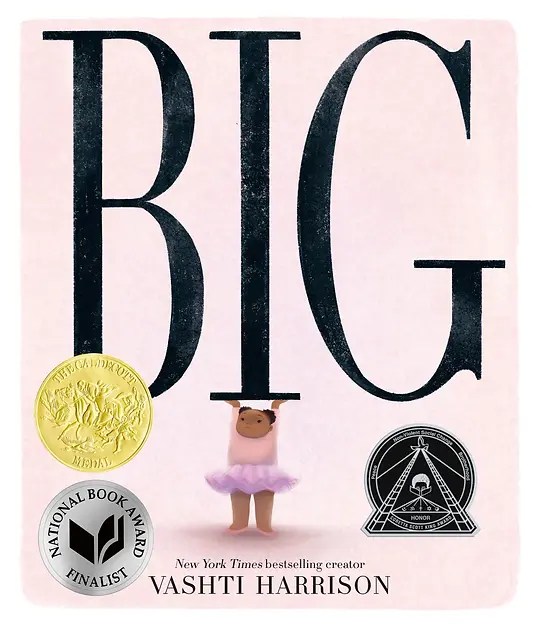
In “Big” by Vashti Harrison, a young girl learns to embrace her size and strength, realizing that being big is a wonderful thing. She discovers that her unique qualities make her special and capable of great things. Through her journey, she gains confidence and learns to love herself just the way she is.
About the Author
Vashti Harrison is an artist, author, and filmmaker with a passion for storytelling. She earned her MFA in film and video from California Institute of the Arts where she snuck into animation and illustration classes to learn from Disney and Dreamworks legends.

Awards
- 2024 Caldecott Medal
- 2024 Coretta Scott King Award Author Honor
- 2024 Coretta Scott King Award Illustrator Honor
Publisher
Little, Brown Books for Young Readers
Learning Activities
Discussion Questions
Grade 1:
- Who is the main character? What makes her special? (RL.1.1)
- At the beginning of the story, how does the main character feel about being big? What words or pictures show her feelings? (RL.1.1)
- When the main character starts to see the positive side of being big, what happens? How do her actions change? (RL.1.3)
- Look at the illustration where the main character is helping others. How do the pictures show that she is using her size in a good way? (RL.1.7)
- Look at the illustrations. How do the pictures help you understand the main character’s emotions? (RL.1.7)
- Retell the story in your own words. What happened first, next, and last? (SL.1.2)
- Describe a scene where the main character feels happy about being big. What details from the story support your description? (SL.1.4)
Grade 2:
- What happens when the main character first realizes that being big can be a good thing? How does this change her actions? (RL.2.1)
- What is the main idea of the story? How do you know? (RL.2.2)
- Describe a scene where the main character helps someone because she is big. How does this make her feel? (RL.2.3)
- How does the main character’s opinion of herself change throughout the story? What events help her realize that being big is a good thing? (RL.2.3)
- How do the illustrations and text work together to show the main character’s journey? Find an example where the picture adds more information to the story. (RL.2.7)
- Find an illustration that shows the main character feeling proud of herself. How do the details in the picture help you understand her feelings? (RL.2.7)
- Discuss with a partner how the main character’s feelings about being big change after she helps someone. What does this tell you about her character? (SL.2.2)
- Give a short presentation about a specific part of the story where the main character learns something important. Why is this important? (SL.2.4)
Grade 3:
- Present a detailed summary of a key event in the story that shows the main character’s grown. How does this event contribute to the overall theme? (SL.3.4)
- What are some key details in the story that help you understand the main character’s feelings about being big? (RL.3.1)
- What are some key events that lead the main character to embrace her size? How do these events help her grow? (RL.3.1)
- What is the turning point in the story where the main character starts to see her size as a strength? How does this moment change the rest of the story? (RL.3.2)
- What is the theme of the story? How do the events in the story support the theme? (RL.3.2)
- How do the illustrations enhance your understanding of the main character’s journey? Describe a scene where the illustration adds to the text. (RL.3.7)
- Analyze the illustration where the main character is standing tall and confident. How does the artist use color and perspective to show her confidence? (RL.3.7)
- Participate in a group discussion about the scene where the main character realizes her size is a strength. How does this scene affect the rest of the story. (SL.3.1)
Phonics Activities
Grade 1:
- Beginning Sounds: Identify and practice beginning sounds in words from the story such as “big,” “brave,” “help,” and “happy.” (RF.1.2.A)
- Rhyming words: Find and create lists of rhyming words from the story, such as “big” and “dig” or “strong” and “long.” (RF.1.2.C)
- Blending sounds: Practice blending sounds to form words found in the book, like “b-i-g” and “h-e-l-p.” (RF.1.2.B)
Grade 2:
- Long Vowel Sounds: Identify and practice long vowel sounds in words like “brave,” “proud,” and “realize.” (RF.2.3.A)
- Consonant Blends: Find and practice consonant blends in words like “strong,” “proud,” and “brave.” (RF.2.3.B)
- Word Families: Create word families based on words from the story such as “-ig” (big, dig, wig) and “-ave” (brave, wave, save). (RF.2.3.E)
Grade 3:
- Homophones: Discuss homophones that might appear in the story, like “brake” and “break.” (L.3.4)
- Multisyllabic Words: Identify and practice reading multisyllabic words from the story, like “confidence,” “realize,” and “important.” (RF.3.3.C)
- Prefixes and Suffixes: Explore words with prefixes and suffixes, such as “unhappy,” “bravery,” and “helpful.” (RF.3.4.A)
Writing Activities
Grade 1:
- Draw a picture of the main character and write a few sentences describing her. What makes her special? (W.1.2)
- Write a short story about a time when you felt proud of yourself, just like the main character in the book. (W.1.3)
Grade 2:
- Write a summary of the story including the beginning, middle, and end. What is the main message of the book? (W.2.2)
- Write a letter to the main character, telling her why you think she is special and giving her advice on how to stay confident. (W.2.3)
Grade 3:
- Write an opinion piece about why you think being big is a good thing. Use examples from the book to support your opinion. (W.3.1)
- Write a diary entry from the perspective of the main character. How does she feel about being big, and what does she learn by the end of the story? (W.3.3)
Hands-On Activities
- Make masks that show different emotions the main character feels throughout the story and then have the children use the masks to act out scenes from the book.
- Use measuring tools to compare the size of different objects. Discuss how being big or small can be an advantage in different situations.
- Decorate jars and fill them with positive affirmations and compliments. Children can write notes to the main character, encouraging her to stay positive and confident.
- Make a journal from the perspective of the main character. Write entries about her thoughts and feelings at different points in the story.
- Create a poster that highlights the main character’s strengths. Draw pictures and write about how these strengths help her throughout the story.
Social Emotional Activities
- Develop empathy by understanding others’ perspectives. Assign children different characters from the book and have them role-play various scenarios. Discuss how each character might feel and why. Encourage discussion about how the children would feel in the same situation.
- Ask children to keep a gratitude journal where they write down things they are thankful for each day. Relate this back to the book by having them write about what the characters might be grateful for.
- Create a tree on a bulletin board and give children paper leaves. Each time they perform an act of kindness, have them write it on a leaf and add it to the tree. Discuss how the characters in the book show kindness and how it impacts other people.
“Big” by Vashti Harrison is a delightful and inspiring read that encourages children to dream big and embrace their unique talents. It’s a wonderful reminder that greatness comes from within, and that every child has the potential to make a big impact on the world. So, if you’re looking for a heartwarming story to share with the young readers in your life, “Big” is definitely a must-read.
As always, I hope these activities and discussion questions spark some great conversations with your kids. I’d love to hear about your experiences in the comments below.
Don’t forget to follow Top Shelf Tales on Instagram (@top_shelf_tales), share this blog with your fellow educators and librarians, and I’ll see you next week!
 Top Shelf Tales
Leave a comment