
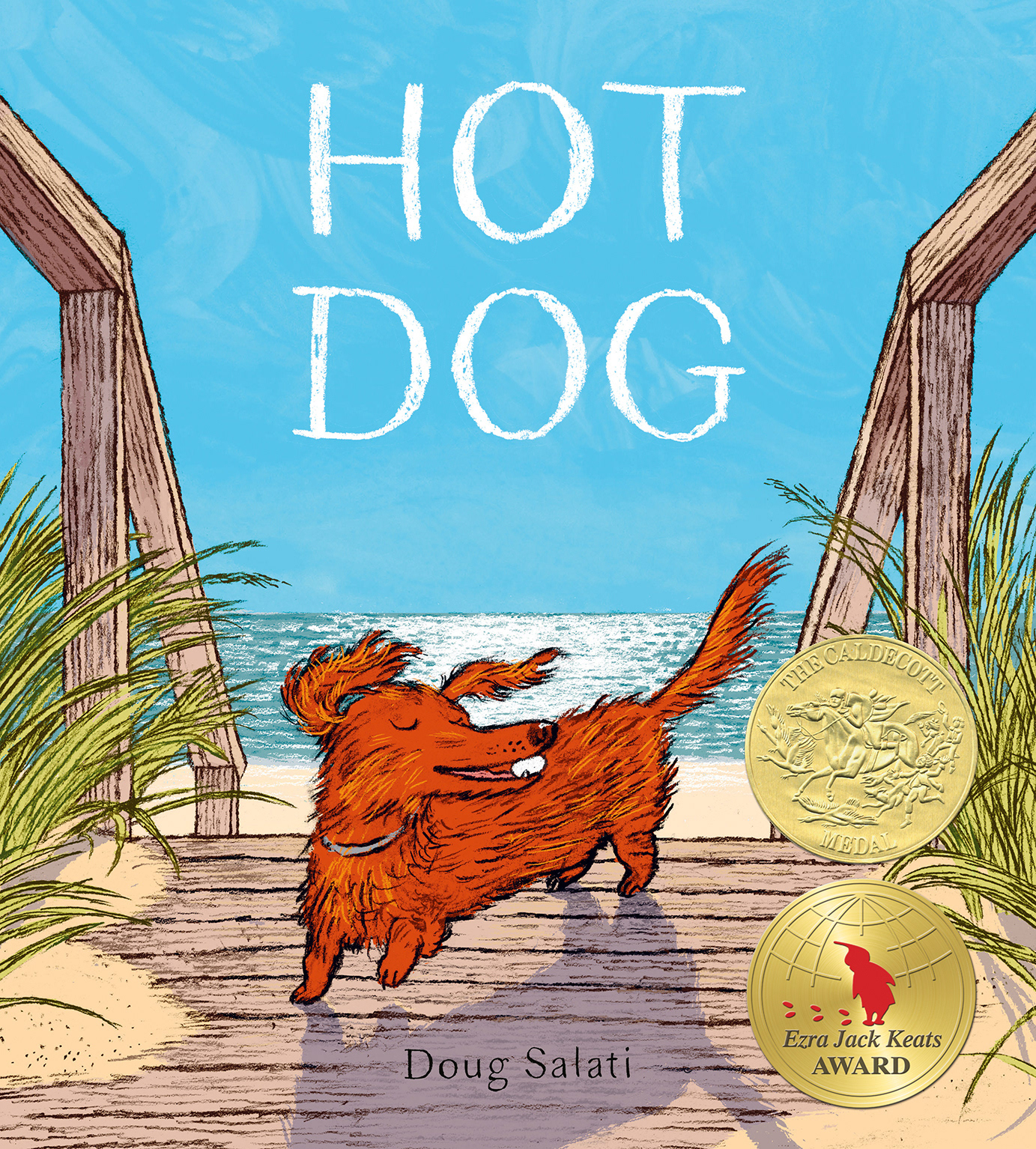
About the Book
In “Hot Dog” by Doug Salati, a little dog feels too hot and overwhelmed by the busy city. To cool down, the dog and its owner take a trip to the beach where they can relax and enjoy the cool breeze. By the end of the day, the dog feels much happier and refreshed.
About the Author
When Doug Salati was a kid, he spent a lot of time reading and drawing, inspired by his favorite illustrators like Maurice Sendak. He studied art in college and even became a competitive swimmer! After college, Doug moved to New York City to continue his art studies and eventually started making his own books

Awards
- 2023 Caldecott Medal Winner
- 2023 Ezra Jack Keats Award
Publisher
Knopf Books for Young Readers
Learning Activities
Discussion Questions
Grade 1:
- Who is the main character in the story? What problem does the main character face? (RL.1.1)
- Why does the dog feel hot and uncomfortable in the city? What clues from the story tell you this? (RL.1.1)
- What is the main message or lesson of the story? Why do you think the author wrote this book? (RL.1.2)
- Describe the setting of the story. Where and when does it take place? (RL.1.3)
- How does the dog’s owner help the dog feel better? What do they do together? (RL.1.3)
- How do the pictures in the book help tell the story? Describe one picture that shows an important part of the story and explain why it’s important. (RL.1.7)
- What is your favorite part of the story? Why do you like it? (RL.1.7)
- Retell the story in your own words. What happened first, next, and last? (SL.1.2)
- Describe the main character using details from the story. (SL.1.4)
Grade 2:
- What is the main idea of the story? How do you know? (RL.2.1)
- What are some ways the dog and its owner try to cool down? Which one do you think works best? (RL.2.1)
- What is the central message of the story? How do the characters’ actions help show us this message? (RL.2.2)
- How does the dog solve its problem? What steps do they take? (RL.2.3)
- How does the dog’s mood change from the beginning to the end of the story? What events cause these changes? (RL.2.3)
- Why do you think the author chose to set part of the story at the beach? How does this setting help the dog? (RL.2.5)
- Discuss with a partner how the illustrations help you understand the story better. (SL.2.2)
- Give a short presentation about your favorite part of the book and why you liked it. (SL.2.4.)
- How do the illustrations and words work together to tell the story? (RL.2.7)
Grade 3:
- Present a summary of the story to the class, including key details and your personal opinion. (SL.3.4)
- What are some key details in the story that help you understand the main character’s feelings? (RL.3.1)
- What do you think the dog learns by the end of the story? How does this experience change the dog? (RL.3.2)
- What is the theme of the story? How do the events in the story support the theme? (RL.3.2)
- How do the actions of the main character affect the events in the story? (Rl.3.3)
- How do the illustrations show the difference between the city and the beach? What details stand out to you? (Rl.3.7)
- How do the illustrations enhance your understanding of the story? Can you describe a scene where the illustration adds to the text? (RL.3.7)
- Participate in a group discussion about the themes of the story. What lessons can we learn from it? (SL.3.1)
Phonics Activities
Grade 1:
- Make a list of the words and phrases in the story that help you understand how the dog is feeling. (RL.1.4)
- Short Vowel Sounds: Identify and short vowel sounds in words like “hot,” “dog,” “cat,” and “sun.” (RF.1.2.A)
- Rhyming Words: Find and create lists of rhyming words from the story such as “dog” and “log” or “hot” and “pot.” (RF.1.2.C)
- Blending Sounds: Practice blending sounds to form words found in the book, like “h-o-t” and “d-o-g.” (RF.1.2.B)
Grade 2:
- Make a list of the words and phrases the author uses to describe the setting. How do these descriptions help you imagine the place? (RL.2.4)
- Long Vowel Sounds: Identify and practice long vowel sounds in words like “beach,” “cool,” and “breeze.” (RF.2.3.A)
- Consonant blends: Find and practice consonant blends in words like “trip,” breeze,” and “sand.”(RF.2.3.B)
- Word families: Create word families based on words from the story such as “-ot” (hot, pot, not) and “-og” (dog, log, fog). (RF.2.3.E)
Grade 3:
- Prefixes and Suffixes: Explore words with prefixes and suffixes, such as “uncomfortable” and “happiness.” (L.3.4.A)
- Make a list of the words and phrases in the story that help you understand the mood. How does the mood change from the beginning to the end of the story? (RL.3.4.)
- Multisyllabic Words: Identify and practice reading multisyllabic words from the story, like “overwhelmed,” “comfortable,” and “refreshing.” (RF.3.3.C)
- Prefixes and Suffixes: Explore words with prefixes and suffixes, such as “uncomfortable” and “happiness.” (RF.3.4.A)
Writing Activities
Grade 1:
- Write a short narrative about a time you felt hot like the dog in the story. What did you do to cool down? (W.1.3)
- Draw a picture of your favorite part of the story and write a sentence about it. (W.1.8)
Grade 2:
- Write a letter to the main character giving them advice about how to stay cool in the city. (W.2.3)
- Write a summary of the story, including the beginning, middle, and end. (W.2.8)
Grade 3:
- Research ways to keep cool in the summer and write a paragraph explaining one method. (W.3.8)
- Write a narrative from the perspective of the dog. How does the dog feel throughout the story? (W.3.3)
Hands-On Activities
1. Set up a small area with fans, water spray bottles, and ice packs. Let the children experience different ways to cool down, just like the dog in the story.
2. Have children create their own illustrations of the dog in different settings (city, beach, park).
3. Create a mini beach in a bottle using sand, small shells and water. After they have decorated their bottles, they can write a short description of what is going inside their beach scene.
4. Make a chart to track the temperature and weather over a week and discuss how different weather affects how we feel and what we do. Do we go outside or stay indoors? What kind of clothes do we wear? Relate it back to how the dog felt in the book.
5. Create dioramas comparing the busy city and the relaxing beach. After building their scenes, they can write a comparison of the two settings.
6. Have children work in groups to make a story map that outlines the key events in the book, drawing pictures and writing descriptions for each part of the book showing the dog’s journey from the city to the beach.
7. Challenge the children to design their own inventions to help the dog stay cool. Have them draw their invention, write up a description, and then present it to the group.
Social Emotional Activities
1. After reading the book, discuss the different emotions the dog experiences throughout the story. Create an “emotion wheel” where students can point to or write down how the dog feels in different parts of the book. Then, have students share times when they felt the same way.
2. Have a discussion with the children about how the dog feels overwhelmed and stressed in the hot, busy city. Taking a break from the city and going to the beach helped the dog feel more relaxed and comfortable. Ask the children if they can remember a time they were stressed or overwhelmed? How did they manage their emotions? What did they do to feel less stressed? Make a list of things that we can do when we feel overwhelmed that may help to keep us calm.
3. Create a paper chain where each link represents an act of kindness performed by a student. Discuss how the dog in the book shows kindness and how it makes a difference. Add a link to the chain each time a student performs a kind act.
4. Have children draw a picture of something they are grateful for, inspired by the dog’s happy moments in the book. Share and discuss these drawings with the group to build a sense of community and appreciation.
5. Present children with different scenarios from the book where the dog faces challenges. Ask them to brainstorm and role-play different solutions. Discuss how the dog overcomes obstacles and how they can apply these problem-solving skills in their own lives.
Doug Salati’s Hot Dog is the perfect story to help kids understand mindfulness, empathy, and the importance of taking time to enjoy the simple things.
As educators and librarians, you have the unique power to bring books to life in your classrooms and libraries. I hope these activities and discussion questions spark some great conversations with your kids. I’d love to hear about your experiences in the comments below – let’s inspire each other to make the most of Hot Dog in our teaching and reading programs.
I’m excited to continue joining forces to nurture a love for reading and a deeper understanding of social-emotional learning in young readers. Don’t forget to follow Top Shelf Tales on Instagram (@top_shelf_tales) and share this blog with your fellow educators and librarians, and I’ll see you next week!
 Top Shelf Tales
Leave a comment